Thursday, July 14, 2011

Crowning of Charles VII Anniversary

“… the Dauphin will be made King, and it is I who will conduct him to the coronation.”

On July 17, 1429, Joan of Arc fulfilled her mission to lead Charles VII to his coronation and anointing as King. Joan had predicted that she would lead Charles to his crowing in Reims when she had begun her mission only a few months earlier. What had seemed impossible to everyone except Joan occurred that summer day in late July of 1429 in the Cathedral of Reims when Charles VII was crowned King of France. All the French people loyal to Charles rejoiced at his crowning as echoed by Christine de Pisan in her epic poem The Song of Joan of Arc:

"Now let us welcome our King!
Rejoice at his return from his fall,
overjoyed at the site of his splendor.
Let us all both great and small
step forward to greet him-no one
hold back-salute him with joyful face.
Praising God who has been so kind
let shouts of "Noel!" fill the place."

Christine’s poem was finished shortly after the crowning of Charles VII in Reims and reflects the national sentiments toward Joan of Arc at that time and is well worth reading to better understand the huge impact that this event had upon the people of France. An English translation is available online at MaidOfHeaven.com at
The Song of Joan of Arc by Christine de Pisan

You can also learn more about the coronation and the city of Reims by visiting this page about:
Joan of Arc & Reims

Vive la Joan

Wednesday, July 6, 2011

The 600th Anniversary of Joan of Arc’s Birthday

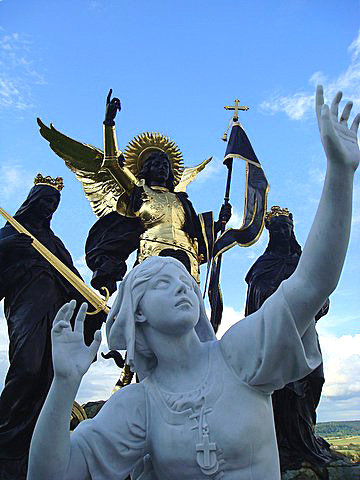
Next year will mark the 600th anniversary of the birth of St. Joan of Arc and we are now only six months away from this milestone so I thought it was a good time to make sure that everyone is aware of what is coming. There are many events planned worldwide to celebrate including a parade in New Orleans and a pilgrimage in France to name just a few. The picture below of the statue of Joan with her Voices at the Basilica of St. Joan of Arc near Domremy was taken just last month and you can see how the statues have been recently cleaned and re-painted to get ready.


How are you planning to celebrate Joan’s 600th birthday anniversary next year?

Learn more abut Joan’s birthday and the 600th anniversary at:
Joan of Arc's Birthday

Thursday, June 16, 2011

Joan’s Great Victory at Patay

June 18th is the anniversary of Joan’s great victory at Patay on June 18, 1429. While this was Joan’s most overwhelming victory where she annihilated an English army of a least six thousand while losing only a handful of men I have never felt that she receives proper credit for this great victory by most modern historians. Examples of what I mean can be found in the book Joan of Arc: A Military Leader published in 1999 where author Kelly Devries says that “she assisted in the French victory at the battle of Patay” and online in the wikipedia article (disclaimer: I do not consider wikipedia to be a valid historical reference) which says: “Although credited to Joan of Arc, most of the fighting took place at the vanguard of the French army and the battle was over before the main body could arrive.” To me such “criticism,” and that is what it is, would be like saying that Robert E. Lee does not deserve credit for the great victory at Chancellorsville because he was not personally present with Jackson’s flanking corps which is something no true historian would ever try to argue.

I wrote a good article last year about Joan of Arc and the Battle of Patay that relies heavily upon the words of the people present and clearly shows just how much Joan was responsible for the victory at Patay. Please read it and decide for yourself exactly how much credit Joan deserves in leading the French to their overwhelming victory at Patay.

Joan of Arc & the Battle of Patay

Friday, May 27, 2011

Memorial Day and Joan of Arc

How appropriate that Memorial Day this year falls on the anniversary of Joan of Arc’s death on May 30, 1431, which is her Feast Day. Memorial Day began in America as a way to remember fallen soldiers and honor them for their service and ultimate sacrifice. While Saint Joan of Arc was not an American soldier she certainly was the epitome of a true soldier and deserves to be remembered and honored for her service to all humankind. Joan’s feast day is celebrated every year by Catholics on the anniversary of her death and is essentially her memorial day. There is a special page at MaidOfHeaven.com commemorating Joan’s Feast Day which gives eyewitness accounts of her last moments and the heroic way that she died. Joan of Arc Feast Day
As we honor and remember our brave soldiers here in America today I hope everyone will also take a moment to remember and honor Saint Joan of Arc in a similar way for the great soldier of God that she was.
Vive la Jehanne!

Sunday, May 8, 2011

Victory at Orleans

On a May 8th Sunday like today in 1429 Joan of Arc achieved complete victory at Orleans. On the morning of May 8th following the previous day’s spectacular storming and taking of the fort Les Tourelles by the French, the English defenders remaining around Orleans left their siege positions and assembled in order of battle in an open field near the city. The French forces came out of Orleans to oppose the English and for an hour the two armies faced each other. During this time Joan called for mass to be held. A citizen of Orleans, Jean de Champeaux, later testified as to what happened next: “The masses completed, Joan said to look and see whether the English were facing them. "No, the English are turned towards Meung,” someone replied. ‘In God’s name,’ Joan replied, ‘They are going. Let them go, while we go give thanks to God and pursue them no farther, since today is Sunday.” And thus total victory was achieved at Orleans as the English retreated away from Orleans. Joan and her army returned to Orleans and celebrated with the citizens of Orleans, a celebration that is renewed every year on May 8th in honor of the “Maid of Orleans.”

Friday, April 29, 2011

Anniversary of Joan Entering Orleans

On April 29, 1429, Joan arrived before the city of Orleans with her army and was greeted by the military commander of the city Jean Count of Dunois who was known as the Bastard of Orleans. Joan was not happy that her captains had not chosen the most direct route to Orleans and displayed her anger in responding to the greeting by Dunois: "Are you the Bastard of Orleans? Was it you who gave counsel that I come here, on this side of the river, and that I am not to go directly where are Talbot and the English?" Joan went on to say:
"In God's name, the counsel of our Lord is safer and wiser than yours. You have thought to deceive me, and you deceive yourself still more; for I bring you better succor than ever came to any knight or city whatever, seeing that it is the succor of the King of Heaven. Nevertheless, it comes to you not through love of me; it proceeds from God himself, who at the request of Saint Louis and Saint Charlemagne, has had pity for the city of Orleans, and has not wished that the enemy should at the same time possess the person the duke and his city."
Despite the harsh greeting, Dunois was thrilled at the arrival of Joan and her army and later described how he felt that the circumstances of her arrival and a miraculous changing of the wind that aided in their crossing of the river Loire into the town led him to believe Joan could only have been sent by God:
“And she crossed the river Loire with La Hire and myself, and we entered all together the town of Orleans. These are the reasons why I think that Joan, and all her deeds in war and in battle, were rather God's work than man's: the sudden changing of the wind, I mean, after she had spoken, which gave hope of aid, and the bringing in of the provisions in spite of the English, who were much stronger than the royal army, and the fact, furthermore, that this young girl swore that she had had a vision in which Saint Louis and Saint Charlemagne prayed to God for the safety of the King and of this city."
To learn more about Joan’s entry into Orleans visit this page about Orleans and Joan of Arc at MaidOfHeaven.com

Saturday, March 26, 2011

Joan The Woman

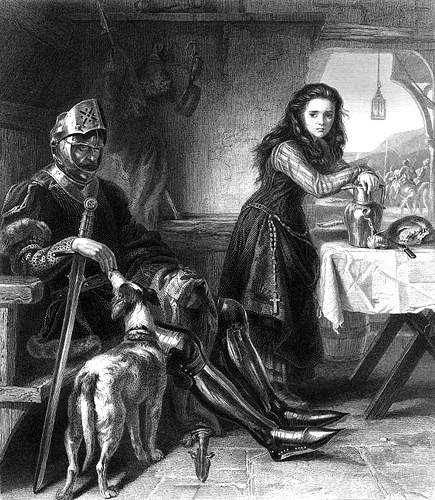
When people picture Joan of Arc they generally see her as either the great warrior or the inspired saint, both of which she certainly was, however she was also at her core a simple young woman and really probably more accurately just a girl. I recently acquired an engraved plate of the picture of Joan above that I really love because of the way that the artist portrays Joan. According to the information I found about this artist, Henrietta Ward, she was inspired to paint this scene by the words below by the nineteenth century English writer Philip Henry Stanhope (Lord Mahon) who said of Joan: "Her young heart beat high with enthusiasm for her native France, now beset and beleaguered by the island strangers. Her young fancy loved to dwell on those distant battles, the din of which might scarcely reach her quiet village, but each apparently hastening the ruin of her fatherland. We can picture to ourselves how earnestly the destined heroine-the future leader of armies-might question those chance travelers whom, as we are told, she delighted to relieve, and for whose use she would often resign her own chamber, as to each fresh report from the changeful scene of war."

When I look at Joan in this picture I see in her face a look of consternation and concern for the beaten down soldier of France which reveals the deep love and compassion that she possessed for the people of her country. It reminds me of the words that Joan’s own mother later spoke about her: “Because the people suffered so much, she had a great compassion for them in her heart and despite her youth she would fast and pray for them with great devotion and fervor.”

This picture also reminds me just how young Joan was: only sixteen when she left home for good and only a few months into her seventeenth year when she led the armies of France to victory. As I contemplate all that this exquisite picture conveys I am left with the thought:

“With God all things are possible”