Showing posts with label battle. Show all posts

Tuesday, June 18, 2013

Battle of Patay Anniversary: Joan's Great Victory!

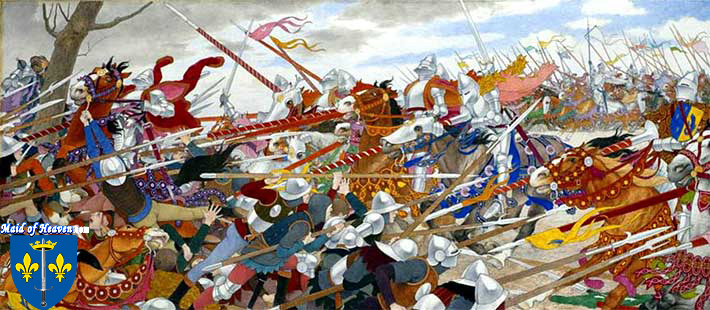
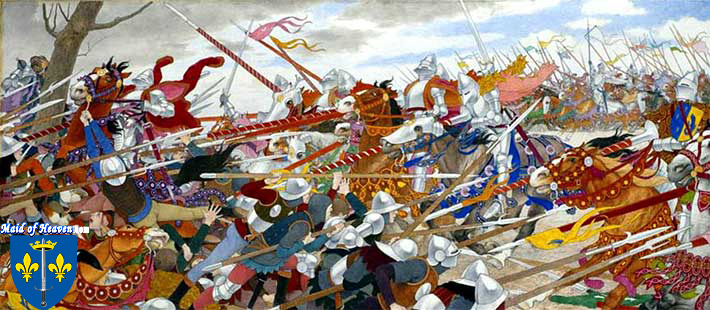
On June 18, 1429, Joan of Arc achieved her most overwhelming victory in her military career when her forces annihilated an English army of over 6000 that had been sent to stop her after her victory at Orleans the previous month. This battle was a very lopsided affair with the English losing almost their entire army while the French suffered a loss of only a handful of men.  The devastating effect that this battle had upon the English and their leadership is best seen in their actions after this battle.  Never again would they aggressively challenge Joan to fight as they had done prior to Patay but instead would seek a course of political maneuvering in order to try to stop her from driving them out of France.  Unfortunately in recent times Joan does not seem to get the credit she deserves for this impressive victory with many modern historians diminishing her role in the battle.  What may be the best argument for Joan's true role in the great victory at Patay is probably the very actions of the English leaders after Patay because it is very clear that Joan is the one who they feared after their devastating defeat at Patay.  To learn more about the Battle of Patay and about what a great military leader Joan of Arc truly was please read the paper I wrote several years ago about Joan of Arc & the Battle of Patay.

Tuesday, May 7, 2013

Joan of Arc's Longest Day & Victory in Orleans

"The next day May 7, 1429 would be long 
and hard, but would end with spectacular success.
You asked Father Pasquerel to always stay near 
your side, so he could aid you in your distress.
'Tomorrow blood will flow from my body, above 
the breast,' to the father you had to confess."
 from Maid of Heaven: The Story of Saint Joan of Arc

On May 7,1429 in Orleans St. Joan of Arc led the french forces against the seemingly impregnable fortress Les Tourelles held by the English. The day before Joan had told her confessor Father Pasquerel: “Rise tomorrow very early, earlier even than today, and do the best that you are able. It will be necessary to keep always near me, for tomorrow I shall have much to do, and greater need of you than I have ever had. Tomorrow the blood will flow from my body, above the breast.” During the course of the fighting Joan was severely wounded as she had predicted when an arrow pierced her body just above her breast. Without Joan to lead them the soldiers and their commanders quickly lost their resolve fearing the battle was lost without Joan and the assault on Les Tourelles appeared as if it would end in failure. Then the miraculous occurred when Joan re-appeared on the battlefield and seized her banner and lead the French army forward to make another assault upon Les Tourelles. Jean d'Aulon, who was the head of Joan's military household, later recalled the amazing turn of events: ". . . the lords and the captains who were with her, seeing that they could not well gain it this day, considering how late it was and also that they were all very tired and worn out, agreed among them to sound the retreat for the army. This was done, and, at the sound of the trumpet call, each one retreated for the day. During this retreat, [d'Aulon] who had been carrying the standard of the Pucelle and still holding it upright in front of the boulevard was fatigued and worn-out, and gave the standard to one named Le Basque, who was with the Lord of Villars. And because [d'Aulon] knew Le Basque to be a brave man, and he feared that harm would come from the retreat, and that the fortress and the Boulevard would remain in the hands of the enemy, he had the idea that if the standard were pushed ahead, due to the great affection in which it was held by the soldiers, they could by this means win the boulevard. And then [d'Aulon] asked Le Basque if he would follow him when he entered and went to the foot of the boulevard; he said and swore he would this. And then [d'Aulon] entered the ditch and went up to the base of the side of the Boulevard, covering himself with a shield for fear the stones, and left his companion on the other side, believing that he would follow him step-by-step. But when the Pucelle saw her standard in the hand of Le Basque, because she believed that she had lost it, as [d'Aulon] who had been carrying it had gone into the trench, she came and took the standard by the end in such a way that he had to let it go, crying, "Ha! My standard! My standard!" And she shook the standard in such a way that the one who is testifying imagined that others might think that she was making a sign to the others by doing this. And then he who was speaking cried: "Ha, Basque! Is this what you promised me?" And then Le Basque tugged at the standard that he dragged it from the hand of the Pucelle, and after this, he went to [d'Aulon] and brought the standard. Because of these things, all those in the army of the Pucelle gathered together and rallied again, assailed this boulevard in such great fierceness that, a short time afterwards, the boulevard and the fortress were taken by them, and abandoned by the enemy, and the French entered the city of Orleans by the bridge . . ."
This was indeed Joan of Arc's "Longest Day" and a day that not only led to victory at Orleans but was also the turning point in the Hundred Years War. 
Monday, June 18, 2012

Anniversary of Joan's Great Victory at Patay


Today is the anniversary of Joan's great victory at the Battle of Patay, which was the most overwhelming victory that she achieved in her brilliant military career. After the battle of Orleans the English military leaders were concerned but still confident they could defeat the French when they engaged in combat. After the overwhelming victory by Joan of Arc at Patay the English leaders realized they were in serious trouble and that Joan was a real military commander to be feared. While this was indeed Joan’s most overwhelming victory where she annihilated an English army of a least six thousand while losing only a handful of men I have never felt that she receives proper credit for this great victory by the French by most modern historians. I wrote a good article a few years back about Joan of Arc and the Battle of Patay that relies heavily upon the words of the people present and clearly shows just how much Joan was responsible for the victory at Patay. Please read it and decide for yourself exactly how much credit Joan deserves: 
Joan of Arc & the Battle of Patay

Wednesday, November 2, 2011

Last Great Victory for Joan of Arc

"I am not alone! I have fifty thousand of my own company to fight with me!"

In the autumn of 1429, Charles VII seems to have been completely under the influence of his advisors who urged negotiation rather than battle. In light of this policy Joan of Arc was used in only a limited role when it suited the King and his advisors. For whatever reason they decided to send her to the strategically insignificant town of St. Pierre le Moutier where Joan once again showed her military brilliance by capturing the town despite having limited troops and supplies with which to overcome a stout defense.

During the battle when it appeared that all was lost and her men were retreating Joan again showed her courage and great leadership in completely turning the course of the battle. Joan’s aide-de-camp(my modern title) Jean d’Aulon describes the scene later at her trial of rehabilitation: “After the Maid and her soldiers had maintained the siege before the city for some time, an assault was ordered and made and all did their duty. But because of the great strength of the place, and also the great resistance made by those within, the French were forced to retreat. At this hour he who speaks, being wounded by an arrow in the heel, as such without crutches I could neither move nor sustain myself, saw that the Maid had remained behind with very few soldiers indeed. Fearing what might follow I mounted a horse, and hastily riding to her I asked her what she was doing there alone and why she had not retreated like the rest of the men. But the Maid, lifting the face guard of her helmet replied: ‘I am not alone! I have fifty thousand of my own company to fight with me and retreat I will not until I have taken this town.’ Whatever she might have said she had not with her more than four of five men, as I know for certain as do several others who were looking on, so I urged her to retreat like the rest. Then she told me to tell the men to bring faggots and brush to make a bridge across the moat which she yelled to the rest in a loud voice.”

Shortly thereafter the moat was filled and the town was taken by assault with little resistance to the amazement of d’Aulon. St. Joan of Arc once again prevailed against impossible odds however this was to be her last great victory. While she continued until her capture to have military successes she never again stormed and captured a city the way she did that day in early November of 1429 at Saint Pierre le Moutier.


***(Joan's words at St. Pierre le Moutier are very similar to those of the prophet Elisha in 2 Kings 6:23-24 about the unseen army of God all around us.)

Thursday, June 16, 2011

Joan’s Great Victory at Patay

June 18th is the anniversary of Joan’s great victory at Patay on June 18, 1429. While this was Joan’s most overwhelming victory where she annihilated an English army of a least six thousand while losing only a handful of men I have never felt that she receives proper credit for this great victory by most modern historians. Examples of what I mean can be found in the book Joan of Arc: A Military Leader published in 1999 where author Kelly Devries says that “she assisted in the French victory at the battle of Patay” and online in the wikipedia article (disclaimer: I do not consider wikipedia to be a valid historical reference) which says: “Although credited to Joan of Arc, most of the fighting took place at the vanguard of the French army and the battle was over before the main body could arrive.” To me such “criticism,” and that is what it is, would be like saying that Robert E. Lee does not deserve credit for the great victory at Chancellorsville because he was not personally present with Jackson’s flanking corps which is something no true historian would ever try to argue.

I wrote a good article last year about Joan of Arc and the Battle of Patay that relies heavily upon the words of the people present and clearly shows just how much Joan was responsible for the victory at Patay. Please read it and decide for yourself exactly how much credit Joan deserves in leading the French to their overwhelming victory at Patay.

Joan of Arc & the Battle of Patay

Wednesday, September 8, 2010

Joan of Arc's Attempt to Liberate Paris

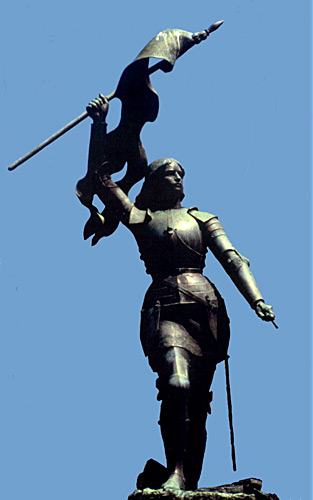
This beautiful statue of Joan of Arc is located at Place des Pyramides in Paris. Unfortunately, Joan herself never saw more than the outside walls of Paris as the attempt she made to liberate the city on September 8, 1429, ended in failure. This was Joan’s first military defeat however the circumstances that led to the failure at Paris were clearly not her fault. Perhaps the biggest factor was the delay caused by the King in launching the assault on Paris after Charles VII had been crowned King on July 17, 1429. If Joan and her army had been allowed to immediately march upon Paris after the coronation they most likely would have gained an easy victory as there were only a small number of Burgundian troops guarding the city at that time. Instead of immediately marching to Paris, Charles hesitated and agreed upon several worthless treaties with Burgundy promising peace. The delay allowed the Burdundians the time they needed to strengthen their defenses and obtain re-inforcements from the English. Such delays in military history have usually proven to be extremely costly e.g., Napolean at Waterloo, Germans with Operation Barbarosa, Confederate Army at Gettysburg to name few.

As for Joan, she did everything she could to lead her army to victory at Paris despite the long odds created by the inexcusable actions of her King. She personally led the assault and kept her troops fighting hard all day in an effort to overcome the great walls of the city. Just after sunset Joan was wounded in her thigh by a bolt from a crossbow. Lying wounded she pleaded with her troops and commanders to continue the assault but they carried her to the rear against her wishes and the assault ended. Joan wanted to renew the assault the next day but orders from Charles VII arrived that no further attempt should be made to take Paris and the army was withdrawn several days afterwards. Joan once stated on the march to the coronation at Reims that she “feared only treachery.” It was ultimately the treachery she had feared and not the enemy that defeated Joan at Paris.
"By my staff, the place would have been taken."

Wednesday, November 4, 2009

Joan of Arc’s Last Great Victory

"I am not alone! I have fifty thousand of my own company to fight with me!"

In the autumn of 1429, Charles VII seems to have been completely under the influence of his advisors who urged negotiation rather than battle. In light of this policy Joan of Arc was used in only a limited role when it suited the King and his advisors. For whatever reason they decided to send her to the strategically insignificant town of St. Pierre-le-Moutier where Joan once again showed her military brilliance by capturing the town despite having limited troops and supplies with which to overcome a stout defense.

During the battle when it appeared that all was lost and her men were retreating Joan again showed her courage and great leadership in completely turning the course of the battle. Joan’s aide-de-camp(my modern title) Jean d’Aulon describes the scene later at her trial of rehabilitation: “After the Maid and her soldiers had maintained the siege before the city for some time, an assault was ordered and made and all did their duty. But because of the great strength of the place, and also the great resistance made by those within, the French were forced to retreat. At this hour he who speaks, being wounded by an arrow in the heel, as such without crutches I could neither move nor sustain myself, saw that the Maid had remained behind with very few soldiers indeed. Fearing what might follow I mounted a horse, and hastily riding to her I asked her what she was doing there alone and why she had not retreated like the rest of the men. But the Maid, lifting the face guard of her helmet replied: ‘I am not alone! I have fifty thousand of my own company to fight with me and retreat I will not until I have taken this town.’ Whatever she might have said she had not with her more than four of five men, as I know for certain as do several others who were looking on, so I urged her to retreat like the rest. Then she told me to tell the men to bring faggots and brush to make a bridge across the moat which she yelled to the rest in a loud voice.”

Shortly thereafter the moat was filled and the town was taken by assault with little resistance to the amazement of d’Aulon. St. Joan of Arc once again prevailed against impossible odds however this was to be her last great victory. While she continued until her capture to have military successes she never again stormed and captured a city the way she did that day in early November of 1429 at Saint Pierre-le-Moutier.