Showing posts with label france. Show all posts

Wednesday, July 17, 2013

Joan of Arc's Crowning Achievement

“Huzzah after huzzah swept the army from van to rear; and as for Joan, there where she sat her horse gazing, clothed all in white armor, dreamy, beautiful, and in her face a deep, deep joy, a joy not of earth, oh, she was not flesh, she was spirit! Her sublime mission was closing – closing in flawless triumph.”  from Personal Recollections of Joan of Arc by Mark Twain

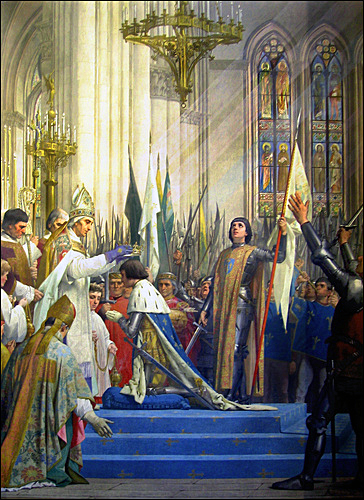
On July 17, 1429, Joan of Arc fulfilled her primary mission to have Charles VII crowned and anointed as King of all France. Joan had predicted that she would lead Charles to his crowning in Reims when she had begun her mission only a few months earlier in 1429. What had seemed impossible to everyone except Joan occurred that summer day in late July of 1429 in the Cathedral of Reims when Charles VII was crowned King of France.  Many people, including historians, have a hard time understanding the strategic brilliance of Joan in focusing upon getting Charles VII crowned in the traditional way so that the people of France would view him as their legitimate King. Joan understood that to achieve ultimate victory over England it was necessary to unite all of France behind one King. Unfortunately for Joan the crowning of Charles VII also marked the pinnacle of her career. But Joan had changed the course of history and the man she crowned King of France would ultimately lead France to complete victory over the English.


Tuesday, July 31, 2012

The Song of Joan of Arc


The Song of Joan of Arc is an epic poem written and finished on July 31, 1429, by Christine de Pisan who was a highly regarded poet who lived in France during the same time as Joan of Arc.  This poem was written and finished shortly after Charles VII was crowned King so it provides a unique view on the momentous events brought about by Joan of Arc during this period of history.  Below is a stanza from the poem describing the coronation of Charles VII: 
"Now let us welcome our King!
Rejoice at his return from his fall,
overjoyed at the site of his splendor.
Let us all both great and small
step forward to greet him-no one
hold back-salute him with joyful face.
Praising God who has been so kind
let shouts of "Noel!" fill the place."

The poem is full of praise toward Joan reflecting the national sentiment at the time after Joan won her great military victories and crowned Charles VII King of France:

"And blessed Maid, are you to be forgotten?
For God has honored you so much using you
against the rope binding France so tightly
which you untied in your debut.
Could our praise ever be enough
for one that we so greatly adore. 
You brought peace to our land,
so greatly ravaged by war"

The full English translation of this famous poem is available online at MaidOfHeaven.com at:
Since today is the anniversary of the completion of this poem it is a good time to read it though to better understand how great a impact Joan of Arc had upon France and world history.

Tuesday, July 17, 2012

Joan Crowns Charles VII Anniversary

On July 17, 1429, Joan of Arc fulfilled her primary mission to have Charles VII crowned and anointed as  King of all France. Joan had predicted that she would lead Charles to his crowning in Reims when she had begun her mission only a few months earlier. What had seemed impossible to everyone except Joan occurred that summer day in late July of 1429 in the Cathedral of Reims when Charles VII was crowned King of France. All the French people loyal to Charles rejoiced as echoed by Christine de Pisan in her famous epic poem The Song of Joan of Arc:


"Now let us welcome our King!
Rejoice at his return from his fall,
overjoyed at the site of his splendor.
Let us all both great and small
step forward to greet him-no one
hold back-salute him with joyful face.
Praising God who has been so kind
let shouts of "Noel!" fill the place."

Christine’s poem was finished shortly after Charles VII was crowned in Reims and reflects the national sentiments toward Joan of Arc at that time and is well worth reading to better understand the huge impact that this event had upon the people of France. An English translation is available online at MaidOfHeaven.com at
The Song of Joan of Arc by Christine de Pisan

You can also learn more about the coronation and the city of Reims by visiting this page at MaidOfHeaven.comt:
Joan of Arc & Reims

Thursday, March 22, 2012

Joan of Arc's First Letter

Joan of Arc sent her first letter to the English on March 22, 1429 asking them to peacefully withdraw from France and give up all of the cities and territories they had conquered and warning them of the consequences if they refused. This letter shows the boldness of Joan as well as her chivalric nature as she believed in giving her enemies a warning before engaging in battle. There is no record of how the English reacted upon receiving this letter however it is not hard to imagine them laughing at what they considered a preposterous threat from a presumptive teenage girl. They were soon to regret not taking Joan and her letter more seriously.

+ Jesus Maria +
King of England, and you, Duke of Bedford, who call yourself Regent of the kingdom France; you William de la Pole, Count of Suffolk; John, Lord Talbot; and you Thomas, Lord Scales, who call yourselves lieutenants of the said Duke of Bedford, do justly by the King of Heaven; render to the Maid who is sent here of God, the King of Heaven, the keys of all the good cities that you have taken and violated in France. She has come here from God to restore the royal blood. She is all ready to make peace, if you will deal rightly by her, acknowledge the wrong done France, and pay for what you have taken. And all of you, archers, companions of war, nobles and others who are before you; and if this is not done, expect news of the Maid, who will go to see you shortly, to your very great damage. King of England, if you do not do this, I am Chef de Guerre, and in whatever place I shall find your people in France, I will make them go
Read the Rest of Joan of Arc's letter to the English here

Saturday, March 26, 2011

Joan The Woman

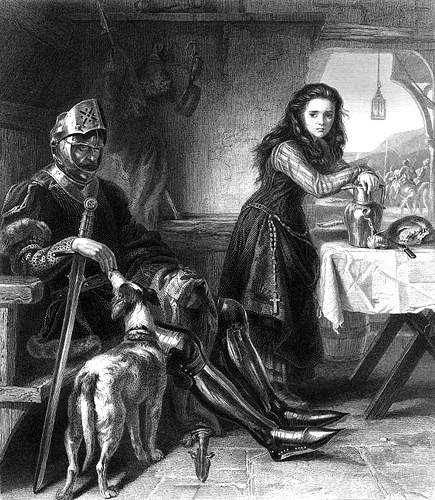
When people picture Joan of Arc they generally see her as either the great warrior or the inspired saint, both of which she certainly was, however she was also at her core a simple young woman and really probably more accurately just a girl. I recently acquired an engraved plate of the picture of Joan above that I really love because of the way that the artist portrays Joan. According to the information I found about this artist, Henrietta Ward, she was inspired to paint this scene by the words below by the nineteenth century English writer Philip Henry Stanhope (Lord Mahon) who said of Joan: "Her young heart beat high with enthusiasm for her native France, now beset and beleaguered by the island strangers. Her young fancy loved to dwell on those distant battles, the din of which might scarcely reach her quiet village, but each apparently hastening the ruin of her fatherland. We can picture to ourselves how earnestly the destined heroine-the future leader of armies-might question those chance travelers whom, as we are told, she delighted to relieve, and for whose use she would often resign her own chamber, as to each fresh report from the changeful scene of war."

When I look at Joan in this picture I see in her face a look of consternation and concern for the beaten down soldier of France which reveals the deep love and compassion that she possessed for the people of her country. It reminds me of the words that Joan’s own mother later spoke about her: “Because the people suffered so much, she had a great compassion for them in her heart and despite her youth she would fast and pray for them with great devotion and fervor.”

This picture also reminds me just how young Joan was: only sixteen when she left home for good and only a few months into her seventeenth year when she led the armies of France to victory. As I contemplate all that this exquisite picture conveys I am left with the thought:

“With God all things are possible”