
Showing posts with label 1429. Show all posts

Tuesday, May 8, 2012

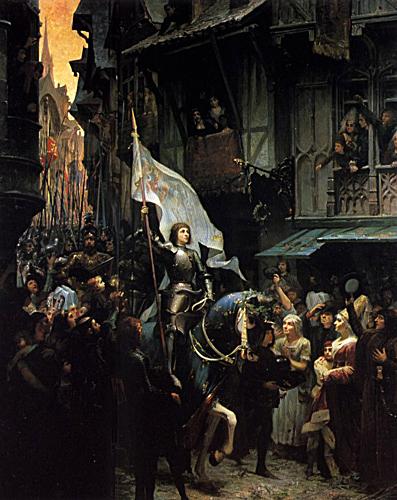
Joan's Victory at Orleans

On Sunday May 8, 1429, Saint Joan of Arc achieved complete victory at Orleans and fulfilled the promise she had made only few months earlier to liberate the city.  On the morning of May 8th following the previous day's spectacular storming and taking of the fort Les Tourelles by the French, the English defenders remaining around Orleans left their siege positions and assembled in order of battle in an open field near the city.  The French forces came out of Orleans to oppose the English and for an hour the two armies faced each other.  During this time Joan called for mass to be held.  A citizen of Orleans, Jean de Champeaux, later testified as to what happened next:  "The masses completed, Joan said to look and see whether the English were facing them.   'No, the English are turned towards Meung' someone replied.  'In God's name,' Joan replied, 'They are going. Let them go, while we go give thanks to God and pursue them no farther, since today is Sunday."  And thus total victory was achieved at Orleans as the English retreated away from Orleans.  Joan and her army returned to Orleans and celebrated with the citizens of Orleans, a celebration that is renewed every year on May 8th in honor of the "Maid of Orleans."
Video of Annual Celebration in Orleans honoring St. Joan
Visit Orleans Fete Jeanne Darc for more info about this year's celebrations.

Sunday, April 29, 2012

Anniversary of Joan of Arc Entering Orleans

On April 29, 1429, Joan of Arc arrived  with her army before the city of Orleans and was greeted by the military commander of the city Jean Count of Dunois known as the Bastard of Orleans.  Joan was not at all happy that her captains had not chosen the most direct route to Orleans and displayed her anger in responding to the greeting by Dunois:   "Are you the Bastard of Orleans? Was it you who gave counsel that I come here, on this side of the river, and that I am not to go directly where are Talbot and the English?" Joan went on to say:

"In God's name, the counsel of our Lord is safer and wiser than yours. You have thought to deceive me, and you deceive yourself still more; for I bring you better succor than ever came to any knight or city whatever, seeing that it is the succor of the King of Heaven. Nevertheless, it comes to you not through love of me; it proceeds from God himself, who at the request of Saint Louis and Saint Charlemagne, has had pity for the city of Orleans, and has not wished that the enemy should at the same time possess the person the duke and his city."

Despite Joan’s harsh words, Dunois was thrilled at the arrival of Joan and her army and later described how he felt that the circumstances of her arrival and a miraculous changing of the wind that aided in their crossing of the river Loire into the town led him to believe Joan could only have been sent by God:

And she crossed the river Loire with La Hire and myself, and we entered all together the town of Orleans. These are the reasons why I think that Joan, and all her deeds in war and in battle, were rather God's work than man's: the sudden changing of the wind, I mean, after she had spoken, which gave hope of aid, and the bringing in of the provisions in spite of the English, who were much stronger than the royal army, and the fact, furthermore, that this young girl swore that she had had a vision in which Saint Louis and Saint Charlemagne prayed to God for the safety of the King and of this city."

To learn more about Joan’s famous entry into Orleans visit this page at MaidOfHeaven.com about Orleans and Joan of Arc.  


Wednesday, September 8, 2010

Joan of Arc's Attempt to Liberate Paris

This beautiful statue of Joan of Arc is located at Place des Pyramides in Paris. Unfortunately, Joan herself never saw more than the outside walls of Paris as the attempt she made to liberate the city on September 8, 1429, ended in failure. This was Joan’s first military defeat however the circumstances that led to the failure at Paris were clearly not her fault. Perhaps the biggest factor was the delay caused by the King in launching the assault on Paris after Charles VII had been crowned King on July 17, 1429. If Joan and her army had been allowed to immediately march upon Paris after the coronation they most likely would have gained an easy victory as there were only a small number of Burgundian troops guarding the city at that time. Instead of immediately marching to Paris, Charles hesitated and agreed upon several worthless treaties with Burgundy promising peace. The delay allowed the Burdundians the time they needed to strengthen their defenses and obtain re-inforcements from the English. Such delays in military history have usually proven to be extremely costly e.g., Napolean at Waterloo, Germans with Operation Barbarosa, Confederate Army at Gettysburg to name few.
As for Joan, she did everything she could to lead her army to victory at Paris despite the long odds created by the inexcusable actions of her King. She personally led the assault and kept her troops fighting hard all day in an effort to overcome the great walls of the city. Just after sunset Joan was wounded in her thigh by a bolt from a crossbow. Lying wounded she pleaded with her troops and commanders to continue the assault but they carried her to the rear against her wishes and the assault ended. Joan wanted to renew the assault the next day but orders from Charles VII arrived that no further attempt should be made to take Paris and the army was withdrawn several days afterwards. Joan once stated on the march to the coronation at Reims that she “feared only treachery.” It was ultimately the treachery she had feared and not the enemy that defeated Joan at Paris.
"By my staff, the place would have been taken."

Friday, July 17, 2009

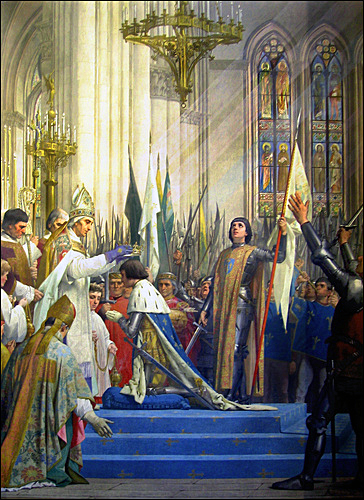
Joan of Arc's Crowning Achievement

“Huzzah after huzzah swept the army from van to rear; and as for Joan, there where she sat her horse gazing, clothed all in white armor, dreamy, beautiful, and in her face a deep, deep joy, a joy not of earth, oh, she was not flesh, she was spirit! Her sublime mission was closing – closing in flawless triumph.”

On July 17, 1429, Joan of Arc achieved what was her greatest accomplishment in liberating France when Charles VII was crowned King of France. Many people, including historians, have a hard time understanding the strategic brilliance of Joan in focusing upon getting Charles VII crowned in the traditional way so that the people of France would view him as their legitimate King. Joan understood that to achieve ultimate victory over England it was necessary to unite France behind one King. Unfortunately for Joan the crowning of Charles VII also marked the pinnacle of her career. But she had changed the course of history and ultimately the man she conducted to throne of France would lead France to complete victory over the English.